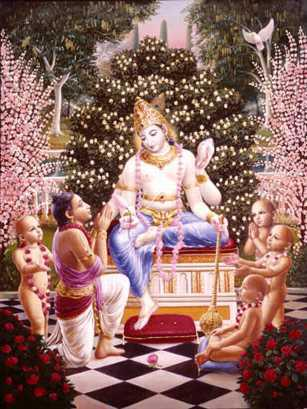
Multiple Reflections of the Same Divine Light

Multiple Reflections of the Same Divine Light

Question: “If Krishna and Amitabha are one and the same then we have two names of God . But who is Dharmakara who, according to mahayana scriptures, once lived as a man(just like Krishna) who became a Buddha . Did God descendent on earth then as Dharmakara who has to reach enlightment, or mayby the story of Dharmakara is not important at all and is mayby not correct.”

Answer from Bhakti Ananda Goswami: I am concerned with World History and Theology, Metaphysics and Philosophy, the Sacred Arts and Sciences and the Revelation, Name and Form of Godhead and Shakti. If one carefully studies what I have written about these Subjects, one should come to understand that the ORIGINAL KRISHNA / KOUROS NEVER CHANGES HIS ORIGINAL FORM and NEVER ‘LEAVES’ GO-LOKA VRINDAVAN. Thus, ALL OF SRI KRISHNA’s VARIEGATED FORMS FOR PASTIMES / LILAS are through, with, in and by Sri Krishna’s Second Person, LORD BALADEVA! In the earliest evidence of HARI-VASUdeva-ATMAN (Krishna-Baladeva-Paramatman) worship, These Three irreducible Forms or KAS / KAYAS / BODIES / PERSONS of the Triune Godhead may be confounded with One-Another. Thus in Pure Land Buddhism the Three Persons of the TRI-KAYA may be telescoped-into Eachother, or their distinct Theological Attributes may be merged. The Persons and Attributes of the Tri-Kaya’s Feminine (Receiving) Shaktis may even be confused and/or merged into the Purusha Persons of the Tri Kaya. So, over thousands of years and miles, and hundreds of cultures and languages, Pure Land Buddhism has flourished leaving a legacy of countless variations in its regional and local Lila Stories, Doctrines and Practices. Read the rest of this entry

Jesus Christ as Asklepios Serapis and Ananta Charaka

Jesus Christ as Asklepios Serapis and Ananta Charaka

God in His form as Dionysus with His Shakti Ariadne from a Water Jar 4th century BC Found near Rhodes

After the technology for Monumental Stone Carving In-the-Round had been perfected ‘Cult Images’ were installed in Greco-Roman and Egyptian Shrines throughout the region. They were installed by the Murti Makers of the Heliopolitan Asyla Federations of Rhodes. The Heliopolitan School of Sculpture of the Murti Makers of Rhodes is credited by Classical Art Historians with the innovation and diffusion of the techniques that finally made the amazing naturalism and realism of this kind of life-size and greater than life- size, monumental statuary possible. Many of these sacred images were severely damaged by the Muslims who later invaded these Mediterranean lands. However, because the Romans and others often made their own copies of very popular Murtis, for their own local temples and shrines, there are enough ‘surviving’ images for the recovered damaged ones to be restored. Thus today we have some original temple and shrine ‘cult images’ that were not destroyed, many thousands of pieces of the ones that were destroyed by the iconoclasts, some that were damaged, but that were restored at some early time, many that were copied in similar or different materials by the Romans and others, and other originals that have been restored in modern times. There are also many modern copies of the most important and famous of these ancient ‘cult images’ or Murtis. Museums often are the actual patrons and/or producers of these replica Murtis, because the Originals or their pieces are in the Museum’s collections. Read the rest of this entry

VIRACOCHA: The Supreme God Vishnu in the Western Hemisphere

VIRACOCHA: The Supreme God Vishnu in the Western Hemisphere

VIRACOCHA is the Supreme God of all of the Andean Tribes and has religious cognates throughout the tribes of the Western Hemisphere. His worship had an ancient center near lake Titicacha and Machu Picchu. The Great Flood Story was prominent among the Andean Tribes and there are many connections between the worship of Vishnu in the Vedic-Vaishnava Flood Story of MANU and the Cultus of Viracocha in the Region of this Lake and Machu Picchu. Macha Puchara ‘Matsya’s Fin’ is the Sacred Peak in the Himalayas that is shaped like Machu Picchu. The totem-pole style of the multi-headed Form of Vishnu / Avalokiteshvara, especially the Bhagavad-gita related Kalah Form is quite obviously the totem-pole style multi-headed Form of Viracocha. Vairocana is a sectarian by-Name of the Adi Purusha in Mahayana Buddhism. There may be a connection between the Names themselves, but the Deity in both cases is obviously the Adi Purusha, the Cosmic and Supra-Cosmic Lord of All.  Viracocha in His totem pole style multi-headed Form. Compare this to the Mahayana Buddhist totem pole style multi-headed Forms of Avalokiteshvara/Vishnu. Some of the Forms of Viracocha the Andean Supreme God are recognizably Forms of Vishnu. Read the rest of this entry

How Old is Hindu Dharma?

How Old is Hindu Dharma?

Kumbha Mela-The World’s Largest Spiritual Gathering takes Place at the Confluence of the Sacred Rivers Yamuna, Ganga and Saraswati, Prayag, India. It was here the Creator Lord Brahma offered his first sacrifice to Purusha (God).

Properly, Sanatana Dharma cannot be called ‘Hindu’ or labled with any other such limiting term of reference, because BY DEFINITION it is eternal and universal. As the ordering laws of the universe or ‘nature’ cannot properly be called American, Russian or Indian (Indus = foreign word ‘Hindu’ for the people beyond the Indus River), Eternal Dharma cannot be said to be ‘Hindu’ or Indian, or time and place limited to any other collective of people or geographical region. If ‘Sanatana Dharma’ could be so limited, it would not be Sanatana Dharma. If you mean how old is some religion called ‘Hindu Dharma’, it would depend on exactly what ‘Hindu’ religion you are referring to. India / Bharata is the home of more than 700 languages and these peoples all have various religious views, which generally in modern times have fallen under the label of ‘Hindu’. I have traced-out the oldest of these living Traditions through over 40 years of exhaustive INTERDISCIPLINARY studies. From all of the available evidence of every kind, the Tradition that I have found with the greatest time depth and widest diffusion is the worship of HARI and/or HARA with Their Shaktis. The great sea and river basin civilizations all worshiped Hari by the Name of NR / MR / NHR / NHL or NRYN / NARAYANA. This is why the ancient Biblical Name of the entire Mesopotamian Region was NHRYM NAHARAIM / NARAYANA. In Egypt the Land of the NHL NILE was called MZRYM. NHRYM = MZRYM ‘Mizrayim’. Later MZRYM became NZRYN ‘NAZAREAN’. The NZRYN religion was that of the mikveoth or Sacred River Baptism practitioners. Thus in India, we can still see this practice in the Kumba Mela and in the other ritual ablutions performed in Sacred Rivers like the Ganga and Jamuna. Such purifying rites are also performed in kunds, lakes and ghats. Read the rest of this entry

Buddha Did Teach About God

Buddha Did Teach About God

1. According to the evidence of Original Pure Land form of Buddhism, Siddhartha Gautama Buddha (Shakyamuni) did reveal the existence of God, as the triune Tri-Kaya or Three Bodies / Forms or Purushas / Persons of the Godhead.

1. Adi Purusha Dharma Kaya = Hrih (Sri Krishna),

2. His emanation savior form = Sambhogya Kaya Hrih (Balarama-Vishnu)

3. His all-pervasive form in the heart of all beings = Rupa Kaya Hrih (Paramatma / Hrih in the heart.) According to the pure land-related Mahayana Buddhist tradition, these teachings could not be heard, received or understood by those of the Theravadin mentality. Only those with the Bodhi heart of compassion could receive the pure land teachings.   Read the rest of this entry

Tara: The Worship of MA Kuan Yin Has NOT Developed From the Separate Worship of Lokeshvara

Tara: The Worship of MA Kuan Yin Has NOT Developed From the Separate Worship of Lokeshvara

Everywhere and at all times in the ancient world, when tending-towards sattvic people worshiped the Supreme Lord and His Shakti/Shekinah, They were ALWAYS worshiped TOGETHER. Thus all forms of Pure Land Buddhism have their origins in the worship of both AMITA-BHA and His SHAKTI. Tara (STAR, ASTRAYA/ASTAREA/STELLA) is one of the Shaktis of Vishnu, and when Pure Land Devotional Buddhism spread into China, TARA was initially worshiped along with Avalokiteshvara (Vishnu) as MA Guan Yin. The earliest Icons/Murtis of Guan Yin that are masculine are simply the Father Avalokiteshvara Kuan Yin Form. As the devotion to Ma Guan Yin (TARA) became ever more popular, the devotion to Father Guan Yin (Lokeshvara) both receded in importance and became absorbed-into a kind of we-don’t-know-and-we-don’t-care devotion to the rather a-sexual form of Guan Yin.  Read the rest of this entry

The Greek Word ‘Krima’ is Cognate with the Sanskrit Word ‘Karma’

The Greek Word ‘Krima’ is Cognate with the Sanskrit Word ‘Karma’

Temple of Aesculapius (Balarama), Villa Borghese, Rome

The actual Sanskrit-Greek cognates in the Judeo-cCatholic Scriptures, the Septuagint, Apocrypha and New Testament, are quite revealing . There really is no need for speculation. However confusion arises when people ignore the authentic Judeo-cCatholic Greek Scriptures. By consulting these Greek Jewish and New Testament scriptures, many countless other profoundly important Jewish and Catholic connections to Vaishnavism are revealed.

In the Judeo-cCatholic Greek Scriptures you will find the Greek word ‘Krima’ and related words for God’s judgment, either favorable or unfavorable, used over 200 times. (See krima [karma], krino [karma], katakrima, katakrisis, krisis [crisis, trial test], kriterion [criteria also], krites and kritikos [critic, critical, judging, judgmental]). The English words ‘crime’ and ‘criminal’ are related to the Sanskrit word karma and the Greek word krima. A criminal is a person who has been judged (and sentenced).

In many of these extremely important Judeo-cCatholic Greek Old Testament, Apocrypha and New Testament verses, the word ‘karma’ could be exchanged for ‘krima’ / ‘krino’ etc. with no change in the verse’s traditional Jewish or Catholic meaning at all. However, it seems that the Calvinist and related Protestant misreadings of the neutral judgment word ‘krima’, always in the extreme negative as ‘damnation’, became the basis of the Protestant Bible’s heavy focus on ‘damnation’ and ‘hellfire’.
Read the rest of this entry

Advaita Vedanta was originally Personal, Monotheistic & Centered on Love

Advaita Vedanta was originally Personal, Monotheistic & Centered on Love

Advaita Vedanta was originally Personal, affirming that the non-dual One is the Lord/God. Such Advaita is an aspect of Monotheism, that defines God as Omnipresent / All-Pervasive. The Omnipresence of the PERSON of the Holy Spirit / Paramatman is not experienced as a mere impersonal light, devoid of Consciousness and Personal attributes! A mere impersonal energy cannot love or experience love! Love is the symptom of the presence of a Person! LOVE IS THE DIFFERENCE Impersonal Brahman ‘Realization’ is NOT the same as experience of the Param-Atman or All-pervasive ATEN/ATUM/ADON-Yahu Feature of Heru-Wasu/Eli-Yahu/Helius/Hari-Vasu the Loving and Lovable Supreme Personality of Godhead!  Of course, as both a Vaishnava and a Catholic bhakta, my own realization is that mental and both subtle and gross forms of temporary and composite material nama-rupa only exist because transcendent and eternal Nama-Rupa exists, and that the advaita Brahman experience of the mayavadi impersonalist does not pass the ‘blinding’ barrier of the Brahma Jyoti, to directly, by His Own revelation, experience the Supreme Personality of Godhead, Who is the Source of the Brahma Jyoti and All spiritual and material realms and worlds.  Read the rest of this entry

Heliopolitan Trinitarian Monotheism: Summarizing a Few of the Main Afro-Heleno-Semitic and Vaishnava Connections

Heliopolitan Trinitarian Monotheism: Summarizing a Few of the Main Afro-Heleno-Semitic and Vaishnava Connections

Sacred Python symbol for life and eternity on a wooden bowl of the Yoruba, Nigeria, Africa, Museum of Mankind, London. The head and neck of the ‘Cosmic Serpent of Eternity’ and the crown of the Male Figure are painted the same exact dark royal blue color inferring commonality. The female figure is holds a rosette flower like symbol. All the archetypal features of Lakshmi-Narayan and Ananta Shesha are present in this artifact. Ananta Shesha is described as having Blue necks and tongues and he is the same being as the blue Narayan. His consort Lakshmi Devi holds a flower in her hand. Even the placement of the divinities corresponds with the positioning of Vedic male and female divinities, with the female standing upon the left, at the heart of God. (excerpted from “The Serpent, The Eagle, The Lion and The Disk” by Brannon Parker)

One Human Family With One Saving God 
Now, it has been over 40 years since I began studying Deity and theophoric (god-bearing) personal, place and city names in the Hebrew and Greek versions of the Bible. I wanted to understand the relationship of the Judeo-Catholic (Apostolic Christian) Deity to the other peoples and deities or Deities of the Old and New Testament stories. At that time I had not been prejudiced by any form of ethnocentrism and had no preconceived notion about where to look for connections, or what I would find. As a result, I was not inhibited to compare Hebrew, Israelite and Judahite Deity names with those of the Deities of Africa, Europe or traditions East of the Levant. I began by searching the scriptures and Biblical concordances for every Deity and theophoric name I could find. There were thousands of them ! Most commonly West Semitic theophoric names were compounded with the Supreme Deity Name elements El (1), Yahu (2) and Baal. Yahu had once been called Baal, Bel or Balu, as was evidenced in Iron Age IIB Israel (3). In Semitic traditions, Baal or Yahu was variously considered the alter-form, Brother or Son of the supreme Deity El. Yahu-Baal was the Form of El who descended to save humanity, as in later Jewish Messianic lore. Semitic Bal was also associated with agriculture / the plow, the club as His astra or symbolic weapon, and the palm tree or palm frond as one of His important symbols (4). He was also as the self-sacrificed POLIEUS (5) associated with sacrificial systems and related sacramental social order civilizations. So, I also searched for Bal-related names. Other important names associated with the Biblical Deity in the Hebrew or Greek, such as ADON-YAHU, ELI-HABHA, ELI-AZAR, ASAR-YAHU, PETHACH-YAHU, ZECHAR-YAHU, and THEOS, BASILEOS, etc., required special attention in my studies.  Read the rest of this entry

Catholic – Vaishnava connections in history

Catholic – Vaishnava connections in history

The following is copyright Pentecost Sunday, 2001 by H.H. Bhakti Ananda Goswami

“AHAM…ASMI…OM” / ” EGO EIMI o ON”
Hari / Eli in the Bhagavad-gita and the Bible

The Greek version of the Jewish Scriptures was once the most used, most prominent version.  It was translated from Hebrew, according to sacred tradition, by the greatest Jewish TSADDIKS (Sadhakas, Sadhus) of the time. This occurred with miraculous divine assistance at the Temple-Library of Serapis (ELI-HABA, HOR-HAP, HARYAPPA ) in Alexandria.  Accepted by Jews throughout the ancient world, this Scripture gives us a unique window into inclusive, inter-national Judaism in the centuries just before the appearance of Jesus Christ. In fact, it is this SEPTUAGINT version of the ‘Old Testamant’ and Apocrypha that was used by Lord Jesus Christ and His disciples.  Thus it was also the version used by the Greek speakers of the early Catholic Church.  Since the Greek of this scripture is closely related to Sanskrit, in the 1960s I decided to study it carefully as part of my comparison between the Judeo-Catholic and Vaishnava Traditions.  What I found is stunning.

The Greek-Jewish names of God, specific religious terms, and literally hundreds of major and minor connections to Vaishnavism pervade the entire Text. Most amazing of all, the Greek translation of God’s Self-revelation in the Exodus story is directly ‘cognate’ with, or linguistically related to Krishna’s words of Self-revelation in the Gita !  In Exodus 3.14 Eli-YHVH says “EGO EIMI o ON” /  I AM BEING (Hebrew I AM WHO AM / YHVH) .  All ‘Indo-European’ Linguists agree that ‘EGO’ is cognate with AHAM,  and EIMI is cognate with ASMI.  ON or AUN is the ancient name of God as ‘BEING’ associated with HERI-AMUN at the Egyptian HERI / ELI Capital City of Heliopolis.  It is Heliopolitan Tradition that is later revived at the Temple of Serapis at Alexandria. So, it is impossible that the Jewish Elders there would not have understood the implication of their choice of words for translating the Divine Self-revelation.  Actually, according to tradition, they were all divinely inspired in their choice of words, this choice being communicated to each one of them individually by the Holy Spirit.  Thus in the East and West, the  central Theophanies of the Two Scriptures, the GITA and the BIBLE are both revelations of the SAME DEITY. Read the rest of this entry

Pure Land Buddhism as Vaishnavism Part Nine: Exposing the Historical Emptiness of Theravadin Buddhist Claims

Pure Land Buddhism as Vaishnavism Part Nine: Exposing the Historical Emptiness of Theravadin Buddhist Claims

So far I have stated that the Buddhist iconography of both the
Northern or Mahayana (with the Pure Land devotional tradition at its
core) and Southern or Hinayana (Theravadin or atheistic) schools is
the same. I have described seeing examples of this canon of sacred
forms from the earliest known Buddhist sites from Japan and Angkor Wat
Cambodia to Nepal and Sri Lanka, the proud `capital’ of Buddhist
atheism. Furthermore I have stated that this symbology and
iconography is easily recognizable as deriving from Krishna-centric
Vaishnavism, as exemplified by the devotional cultus of Sri Krishna
(Hari = HRIH Dharma Kaya Amitabha) and Sri Baladeva (Sankarshan Vishnu
= Sambhogya Kaya Amitayus-Lokeshvara) at Their ancient Indian Center
of devotion in Vrindavana-Mathura. I have explained that authentic
(pure Pure Land) early Buddhism was a form of Krishna-centric
Vaishnavism, but that atheistic Buddhism has misrepresented itself to
the world as the original form of Buddhism. Because the Theravadin
Buddhist elite of Sri Lanka proudly proclaim Sri Lanka to be the
historical capital of Buddhist atheism (Theravada), and this claim is
not disputed in the Theravadin Buddhist world, I have very carefully
sought evidence to support this claim. Since the Sri Lankan
Theravadins themselves assert that their Buddhism first came to Sri
Lanka as part of the Indian Emperor Ashoka the Great’s Buddhist
missionary effort, logically one should be able to understand the
`original’ Buddhism of the island from gaining an accurate
understanding of the Buddhism promoted by Ashoka’s missionaries. So I
carefully investigated the Buddhism of Emperor Ashoka, and here is
what I found. Read the rest of this entry

Good Planets, the Heavenly Jerusalem and Paradise in the Judeo- Catholic Tradition

Good Planets, the Heavenly Jerusalem and Paradise in the Judeo- Catholic Tradition

THE DANCE OF THE BLESSED. Above from the heavenly Jerusalem stream rays of golden light, and two angels who are passing into the portal, are aerial and luminous, as bright and splendid spirits.Light intellectual replete with love, Love of true happiness, replete with joy, Joy, that transcends all sweetness of delight. Heavenly Jerusalem Beckons.

Unfortunately many Vaishnavas have been influenced by the confused
speculations of modern esotericists, like those doctrines
regarding ‘heaven’ taught by Theosophists, and in the related New Age
Movement. Thus the related erroneous teachings of Gnosticism and the
equally erroneous pseudo-Jewish and pseudo-Christian teachings of
Mohammedanism have pervaded the thought of many devotees when it
comes to their misunderstanding of ‘heaven’ in the authentic Judeo-
Christian Tradition.

In authentic Judaism and Catholic Apostolic Christianity, there is an
absolute distinction between the 1. Planets of the material cosmos,
2. the self-effulgent Heaven where the Heavenly Jerusalem (City of
God) is, 3. and the Garden of Paradise where the Hora / Chorus or
Circle Dance of Divine Love, the Rasa Dance of God the Choreagos and
Choruales is !
Read the rest of this entry

When Yahu was Bal, and Eli/ Hari/Heru Was Still Supreme, Part 1

When Yahu was Bal, and Eli/ Hari/Heru Was Still Supreme, Part 1

Baal standing with a club in his raised right hand

HOW DID YAHU-BAAL, THE SECOND PERSON OF THE GODHEAD IN THE JUDAIC TRADITION BECOME BAAL THE SYMBOL OF FALSE WORSHIP AS SHOWN IN THE ‘SHOWDOWN’ BETWEEN ELIJAH THE PROPHET OF YAHWEH AND THE PROPHETS OF THE FALSE GOD BAAL, WHICH ESTABLISHED YAHWEH AS THE TRUE GOD OF ISRAEL?

IS THERE SOME ERROR IN THE TRANSLATIONS OR SOMETHING?

The story about Elijah is commonly misunderstood, because we have not been taught the true historical context for it, and we have not been told that YHVH himself was also originally called Baal.  At one time in that region, the Western Semites worshiped their Supreme God ELI and His savior alter-form ‘Brother’ or ‘Son’ Baal.  Each place also had a presiding form of the Lord there, with the title Baal ‘Lord” or ‘determinitive’ BL compounded with the Deity’s Name.  Although the personal name Baal or BL was first used exclusively for the Savior Deity BL in His multi-form, after the disintegration of the regional Eli-Baal Tradition, this name became the generic title equivalent to ‘lord’.  So people commonly spoke of plural balls or lords, or ‘The Baal’ or lord of this place or that, this shrine, people, village, nation or that one.

Try to understand the difference.  To the monotheists the ORIGINAL BL was present in His many temples, shrines and other consecrated places.  To the polytheists, these were all different and often hostile or competing ‘baals’ or lords.  The monotheists’ vision was of one Lord and one God in many places and forms, worshiped by all humanity.  But the polytheists’ view was of many competing demi ‘gods’ who were only the planetary, animistic, totem or race patron protectors of distinct tribes or races. By the monotheists, Eli, Yahu and Baal were Names used interchangably for the same Supreme Deity, or sometimes Yahu-Baal was distinquished as the alter-form, brother or son of the Supreme Father God ELI (HERU in Egypt, OLU in the Niger-Khordofanian complex, HELI / SOLE among the Greeks and Romans, and HARI / SURA etc. in the East).  This Deity was the Father God of ALL RACES.  In fact the Hebrews, Israelites and Jews (before the anti-Hellenism purge) and other HELIOS / ELIYAHU / HORUS
WORSHIPERS WERE ALWAYS MIXED RACE PEOPLES.  Today people fail to grasp the importance of MONOTHEISM IN THE HISTORY OF HUMAN EQUALITY AND UNITY.  Polytheism did not mean tolerance, it meant the social strife of countless little warring ETHNIC theocracies.  It took the Monotheism of Heli-Os / Eli-Yahu / Heru-Asu / HRIH to unify humanity. Read the rest of this entry